How sales career planning increases earnings. Applying forethought, planning, and preparation to careers in selling.
In conversation with a youthful 23-year-old, we got around to talking about sales career planning. At the time of writing, I was past fifty. You might imagine that we had different perspectives on time.
It made me reach back and touch my sense of the endless school summer holidays. Those long-gone escapes seemed to last forever. Flipping back into the present, I compared the apparent passing of time. Scientists can easily prove that a day in my youth lasted the same amount of time as a day in my middle years. My perception tells me otherwise.
Time seems to be accelerating. Days, weeks, months, and years seem to be flitting past, faster and faster. Perhaps this is a phenomenon of ageing. It certainly draws attention to the pace of change.
If scientists were to measure it, I think they would confirm my sense that change is happening faster and faster.
Long gone are the days when salespeople could pitch up, show a few products and earn a living. In a previous article, When Markets Shift and Buyers Change their Habits, I suggested that modern salespeople need to be in the ‘good ideas’ business. Let’s revisit sales career planning and consider what qualifications might be increasingly important for a sales executive as the future arrives, crashing over our thresholds of perception.
Good ideas on their own aren't much use. Perhaps you can remember the experience of being new to a company and bursting with good ideas that would help others or the organisation succeed.
People can’t hear good ideas from a newbie.
The idea itself may be sound but people don’t listen until you have been around for a while. The message bearer must have credibility as well as logic and enthusiasm on his or her side.
It is much the same in selling. Until you can gain the trust and confidence of a prospect, your great ideas have no standing and are likely to be ignored.
It has always been the case that salespeople who can build rapport and trust fast, have a greater influence over those to whom they sell.
These days people have less time than ever to cogitate and a much greater understanding of sales techniques. Having excellent communication skills and abundant confidence only gets you to first base.
A prominent sales persona can put prospects on their guard rather than build trust.
Today’s salespeople need to establish credibility as a specialist and an expert in the application of what they are selling.
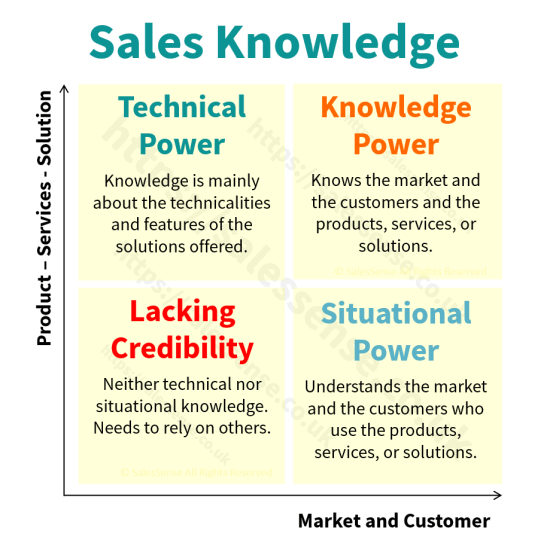
Today's would-be sales stars need to have good knowledge of both their own industry and that of each of their customers so that they can bridge the gap.
No amount of confidence and bravado will make up for a lack of marketplace understanding. Customers listen to their own experts first and the ticket for engaging with a customer's experts is one's own expertise.
Modern B2B sales executives need expertise in:
- Their products, services, and solutions.
- The history of the company represented, its true vision as held by its leaders and policymakers, and its short, medium, and long-term goals and objectives.
- The trends and changes in their market, what the thought leaders are saying and what the competitors are doing.
- The customer and the customer’s market.
Randomly proposed ideas only lead to a loss of credibility. Ideas that are appropriate and practical increase credibility. They take into account the customer's circumstances and market conditions.
Those who have such expertise don't need to flaunt it. Their mastery of these matters is obvious to anyone they converse with about business. It is easy to subtly demonstrate true knowledge and expertise through the questions asked.
While salespeople might rely on their employer for education about products and services, market and customer understanding usually depends on individual initiative and effort.
Fortunately, technology makes it feasible for us to keep up. Using search engine alerts, we can have new information on any topic, person, or company flagged up to us as it happens.
News readers, social media, and Google Alerts make it possible for us to filter out the overwhelming mass of information and see only what we want to see. Numerous email newsletters offer another means to keep abreast of the latest information on selected topics.
Automatic document summarizers can help cut down the amount of reading. Speed reading and photo reading habits make it possible for people to keep up while fulfilling their customer contact and prospecting activities.
It seems to me that a range of new and different skills are now much more important for success in a B2B sales career. The following four competencies are now, ‘must haves’.
- Using technology to filter out unnecessary information
- Assimilating information faster than competitors
- Understanding customer markets and business issues
- Creating ideas to help customers succeed
Mastery of traditional sales competencies is no longer enough to ensure success.
Salespeople who anticipate and prepare for the future before it arrives will continue to reap the high rewards available to outstanding performers.
Author and speaker, Patricia Fripp said, “It is not your customer's job to remember you. It is your obligation and responsibility to make sure they don't have the chance to forget you.”
The more personal value we add, the more entwined we become in the success of our customers.
Article by Clive Miller
If you are looking for sales career planning or development support, we can help. Telephone +44 (0)1392 851500. We will be pleased to learn about your needs or talk through some options. Send an email to custserv@salessense.co.uk for a prompt reply or use the contact form here.