Use a sales competency framework to improve hiring, assessment, coaching, and performance.
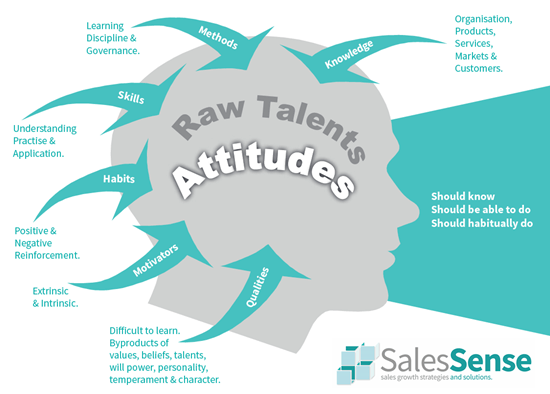
What should good salespeople know, do, and do consistently? A clear sales competency model answers that question and gives you a practical framework for recruitment, appraisal, training, coaching, and progression.
At SalesSense, we help organisations define sales competencies in a way that is specific, observable, and useful in the real world. The result is a framework you can use to assess current capability, identify gaps, and raise performance standards.
Need help defining your sales competencies?
Call 01392 851500, use the contact form, or schedule a Zoom call.
What is a sales competency framework?
A sales competency framework is a structured description of the knowledge, skills, behaviours, and habits that salespeople need in order to succeed in a particular role or market.
It gives managers and salespeople a shared language for performance. Instead of relying on vague judgments such as “good with customers” or “not proactive enough”, you can define success more precisely and assess it more fairly.
A useful framework typically covers:
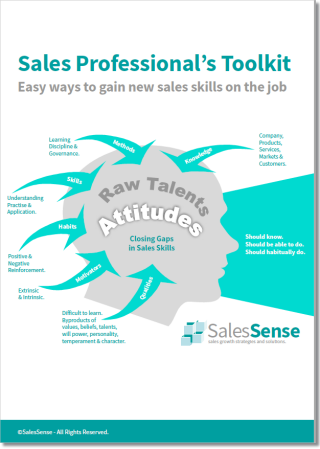
- Knowledge – what salespeople need to understand about customers, markets, products, competitors, and value.
- Skills – what they need to be able to do, such as qualifying opportunities, communicating persuasively, negotiating, and progressing a sale.
- Habits and behaviours – what they must do consistently, such as prospecting, preparing, managing time, and developing themselves.
Why use sales competencies?
A sales competency model makes sales management more objective and more useful. It helps you define expectations, evaluate people against relevant standards, and focus development where it will make the biggest difference.
You can use a sales competency framework to:
- Improve recruitment and reduce costly hiring mistakes
- Structure onboarding for new sales hires
- Benchmark existing sales capability
- Support fairer performance reviews and appraisals
- Identify training and coaching priorities
- Clarify what good looks like in different sales roles
- Strengthen succession planning and career development
In short, it helps convert sales performance from something loosely judged into something more visible, coachable, and improvable.
When do organisations need a sales competency model?
Many businesses start looking at sales competencies when they notice an inconsistency. Some salespeople perform well, others struggle, and managers cannot always explain why. A competency model helps reveal the difference.
It is especially useful when you are:
- Building or restructuring a sales team
- Introducing a more formal appraisal process
- Improving sales coaching and training effectiveness
- Standardising expectations across territories or roles
- Hiring for specialist roles such as BDMs, SDRs, key account managers, or sales managers
- Trying to improve forecast quality, qualification discipline, or sales process execution
Examples of sales competencies
Below is a practical sales competency model built around nineteen factors. You can use these as a starting point and then adapt them to your market, proposition, sales cycle, and role types.
Knowledge and commercial understanding
- Answering common customer questions
- Having credible answers to the questions buyers naturally ask.
- Market and industry understanding
- Knowing the context in which customers operate.
- Customer and prospect understanding
- Understanding how target organisations work and what matters to them.
- Company understanding
- Understanding your own organisation’s goals, capabilities, strengths, and limits.
- Understanding and articulation of value
- Being able to explain the commercial value clearly and convincingly.
Communication and influence
- Written communication
- Writing clearly in emails, proposals, quotations, and digital selling activity.
- Interpersonal communication
- Listening, questioning, presenting, and influencing effectively.
- Handling objections
- Resolving concerns without damaging trust or momentum.
- Negotiating terms
- Securing workable, win-win outcomes.
Pipeline creation and opportunity management
- Proactive prospecting
- Creating opportunities when inbound demand is insufficient.
- Networking for new opportunities
- Using relationships and visibility to open doors.
- Opportunity qualification
- Focusing effort on business worth pursuing.
- Forecast accuracy
- Making realistic judgments about likely outcomes and timings.
- Managing the sales process
- Using a method or framework to guide the sale.
- Progressing a sale
- Helping the customer move through their buying journey.
Personal effectiveness and growth
- Organisation and time management
- Planning well, prioritising well, and following through.
- Self-development
- Improving skills, knowledge, and habits over time.
- Sales mindset
- Maintaining attitudes that support resilience, discipline, and performance.
- Sales motivators
- Understanding the factors that energise sustained effort and achievement.
Not every sales role needs the same weighting. For example, a new business hunter, an account manager, and a technical sales consultant may all need different emphasis within the same overall model.
Why off-the-shelf competency lists are not enough
Generic lists can be useful, but they are rarely enough on their own. A competency framework becomes far more valuable when it reflects your market, your offer, your customers, your sales cycle, and your business goals.
For example, one organisation may need a strong emphasis on strategic account development and complex qualification. Another may need stronger prospecting discipline, better written communication, or improved commercial awareness. The right model should reflect those differences.
That is why many organisations ask us to help them adapt or build a framework that fits their reality rather than forcing their team into someone else’s template.
How we use sales competencies in practice
We use competency frameworks to support a range of commercial improvement initiatives, including:
- Assessment – creating gap assessments and benchmarks for individuals or teams
- Selection – improving recruitment decisions and interview focus
- Onboarding – defining what new hires need to learn quickly
- Training – identifying where development is needed most
- Coaching – helping sales managers and coaches focus on the right behaviours
- Performance management – making appraisals more objective and developmental
Need a sales competency model that fits your business?
We can help you define, refine, and apply a practical sales competency framework for assessment, hiring, development, and performance improvement.
Call 01392 851500, use the contact form, or schedule a Zoom call to discuss your requirements.