Sales Success Formula transcript - part one - successful sales strategies.
This is part one of the transcription accompanying the video presentation. The narrative provides additional insights and ideas to help people use the formula presented in the video to devise their own successful sales strategies. See part two here.
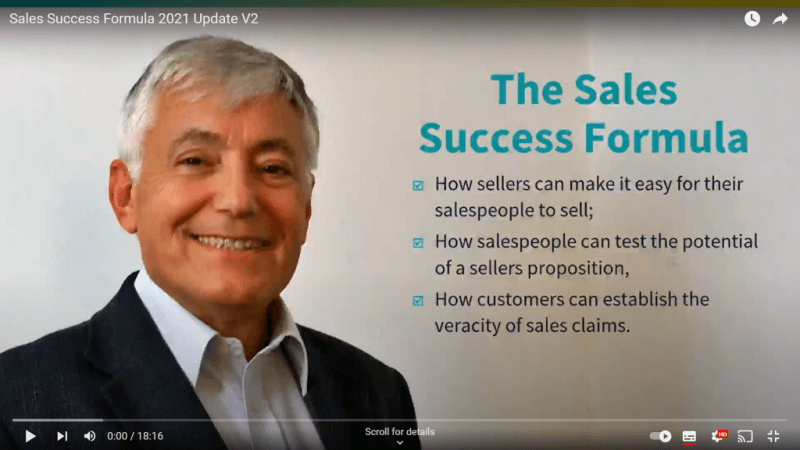
Sales Success Formula Narrative
Thanks for your interest in this resource. My name is Clive Miller and I'm the author of most self-sense material and the sales success formula. In the process of selling technology solutions managing sales teams and developing sales training programmes, I have invested over 40 years of my life in solving sales performance challenges.
Since the frontiers of knowledge and human capabilities keep expanding there is no end in sight. The sales success formula is a set of building blocks rather than a solution.
Every sales environment is unique. Even if a company is offering the same product as its rivals it presents a unique mix of availability, service and support.
No Standard Formula can Fit all Environments
Companies are a collection of individuals. Every business has a unique persona and appeal. No standard sales formula can fit all sales environments.
The sales success formula is a model for creating any number of unique sales frameworks. Each framework provides a blueprint for a particular sales environment and a specific guide for salespeople operating in it.
Because the sales success formula is a framework based on world-class best practices, each business or sales team can adapt it to provide an extraordinary sales resource that is finely tuned to their needs.
Use the formula to apply thinking and intelligence to the steps in your sales process. It will help you to make many small improvements and perhaps a few significant leaps.
Applying the principles and solving the obvious problems will lead to significant sales performance improvement.
Eliminating Uncertainty in the Sales Process
The formula is based on eliminating uncertainty in the sales process. As we move through these slides, I’ll offer additional insights and ideas to help you use the formula summarised here.
- There are some basic questions that everyone asks when they buy anything significant. We refer to them as the top six customer questions. I’ll list them and explain how to structure a powerful response to each question.
- If you have verifiable proof of value that is greater than your asking price, sales skills matter less. If you offer enough value, it doesn’t matter if your salesperson has a bad body odour. I’ll suggest some ways to recognise and articulate value.
- The clearer your target, the better your aim. I’ll suggest some criteria to help you see prospects more clearly before you call on them.
- Getting a hearing is about messaging, timing, and persistence. I’ll explain how to sway the odds in your favour and increase the number of prospects who engage.
- Anticipating objections, constructing effective turnaround responses, and ensuring that they are memorised, enables salespeople to handle any sales challenge that can be imagined.
- I'll explain how using a structured sales process, improves conversion rates, consistency, and results.
- If you follow this guide and compile your own sales framework you may need to teach others how to use it. I'll provide some principles to follow for maximising training effectiveness.
The Top Six Customer Questions
1. Who are [company]?
Characterising and positioning the Company in a memorable, succinct way conveys confidence and builds credibility. Having a prepared and rehearsed two to three-sentence speech communicates professionalism. A top answer would communicate the industries or markets served, geographic presence, a layman's expression of the value created, time in business, and the size of the Company, said in less than 15 seconds.
2. What do you do for customers?
People who ask the second question want to know about the value the Company delivers.
A powerful response would include a short explanation of the top three ways that customers benefit.
3. Who are your top customers and what do you do for them specifically?
People may not ask this third question in a direct manner yet it lingers, wanting to be asked. Being ready with appropriate examples of what you have done for customers who are known to the questioner, convinces.
Explain with facts that could be verified by the listener.
Prepare short succinct explanations so that you can avoid lengthy monologues. Less is more.
Three examples are enough but have others in reserve so that you can easily convey the notion that you have many satisfied customers, without making it a statement.
4. How are you different from other companies that do similar things?
Someone who asks the fourth question is likely to be a buyer of the type of products or services you offer.
A top answer should include between one and three clear distinctions supported by examples of how customers benefit.
Differentiators might include a unique approach, new methods, specialist expertise, and specific capabilities.
Prepared and rehearsed answers are so much more substantial and satisfying.
5. Others have made convincing promises about these things and then not delivered. How can we be sure that you will do what you say you will?
Early in a sales conversation, customers are wary. They are concerned about being subjected to or persuaded by a clever pitch.
Sometimes this concern is expressed as a challenging question like the example above.
Even if a potential customer doesn’t challenge directly, this question is held in mind and answers are sought indirectly.
Prepare some factual verifiable statements that communicate your or your company's integrity.
Lead listeners to form their own conclusions. Never tell them what to think instead provide verifiable facts that point to the conclusion that you want listeners to arrive at.
A top answer would provide verifiable evidence of honesty and integrity. Possibilities include explanations of transparency, a list of standards conformed to, relevant accreditations, methodologies employed, guarantees, and customer references.
6. How could we be sure that we would get the best value if we came to you?
Question six arises for those who prefer to avoid the complication of completing a requirement.
Using three verifiable facts is usually all that is necessary to reassure those who want to be convinced.
Examples of reassurance include a measurable return on investment, the number and status of satisfied customers, the method used to check market competitiveness, the method of calculating prices, and written guarantees.
Anyone asking question six is sending a buying signal. Follow your answer with a question such as, "Do you have a particular reason for asking?" to explore buying interest.
Verifiable Proof of Value
Prepared answers for the top six customer questions involves clearly articulating the value of what you will sell. With proof of value, you can narrow the field.
If you have bread to sell and a list of hungry people you might expect to make some sales.
What is the bread?
- How much does what you sell contribute to a customer's bottom line?
- How does what you sell, save them money?
- How does it save them time?
- How does it help them win more customers?
- How does it help them deliver better products or services?
Answer these questions with verifiable facts to offer proof of value.
Returning to the bread analogy, if you can see a person, you can tell if they are undernourished.
The internet and search tools have made it quite easy to look at companies and learn a lot about them without having called or spoken with anyone who works there.
If you profile your best customers and use this as a template for recognizing suitable prospects, you will greatly reduce the time you waste on unproductive sales campaigns.
What do your Ideal Customers Look Like?
- Markets addressed
- Issues addressed
- Size by the appropriate metric
- Profitability trends
- Turnover trends
- Market position
- Type of stakeholders
- Cultural ideals
- Organisational structure
This Bonus Story Illustrates the Point:
Three apprentice bowmen stand before their teacher.
“See that clay bird in yonder tree”, the teacher asked. They all nodded.
The teacher instructed the first student to take an arrow from his quiver, set it on his bow, and take aim at the clay bird. He did so and as he drew his bow, the teacher asked, “What do you see”? The student replied, “I see a tree in the orchard with a clay pigeon in it”. The teacher indicated that he should continue and make his shot. The arrow struck the ground a few meters from the tree.
The second student stepped forward for his turn and again the teacher asked what he saw. The student declared that he could see the branches of the tree, some leaves, and a clay pigeon. His arrow flew quite close to the pigeon and clattered through the tree.
The third student had a purposeful look on his face. As he took aim, his brow was furrowed with concentration. The teacher asked once more, “What can you see”? “The eye of the bird” came the reply. “What else can you see?” asked the teacher. “Nothing” replied the student as he let his arrow fly. It flew true, straight into the eye of the clay pigeon.
This is the end of the narrative transcript for part one of the Sales Success Formula.
The remaining four aspects of the formula are:
- How to get through to more prospects and have your message acted upon
- how to prepare solutions to all objections and obstacles encountered in the sales process
- how to create and leverage a sales process framework
- how to make training more effective.
Follow this link for more successful sales strategies in part two.
The Sales Success Formula was written and narrated by Clive Miller
If you lack the time or resources to create successful sales strategies, make use of the Sales Success Formula. If you need additional resources to make things happen, we can help. Telephone +44 (0)1392 851500. We will be pleased to learn about your needs or discuss some options. Alternatively, send an email to custserv@salessense.co.uk for a prompt reply or use the contact form here.


Comments