Guaranteed 5% – 35% business performance improvement in 2 – 6 months for participating individuals and teams

Subscriber Gifts

Subscribe free in less than 30 seconds. Subscription bonuses include the Win Predictor; The Power to Speak' e-book; Solutions to common selling obstacles; Special reports, Training tips; Assessments, Reviews and our Sales Drive Journal.

Login

The Power of Benchmarks

How many different strategies might be used to increase sales performance? This is a question I pondered recently while designing a new web site. From a sales managers perspective, obvious strategies include, increasing motivation, raising the bar, training to improve or change behaviour, changing or defining sales process, and measuring task level performance.

Measuring task level performance in isolation isn’t particularly useful. It is when we compare measurements with past performance, peer performance, competitor performance that its potential is released. Everyone is motivated to some degree to beat a personal best. Peer pressure has long been recognised as a powerful motivator. And external competitors provide us with an opportunity to see how we are doing against the market norm and the best in class.

Task level measurement can encompass any criteria that mark progress towards a goal. Obvious measures for sales people include how many inbound telephone calls they deal with and how many outbound telephone calls they make. This data is recorded for each extension and all mobile phones. It can be easily accessed and compiled into trend data which can then be compared with sales performance. A wave of revelation crashes across ones awareness with this one simple measurement.

You might expect a general correlation between work rate and results. This approach will provide the facts. Whether or not performance and work rate are synchronised, it will be valuable to learn more about the way the sales team generates business. Analysis will show not only which sales people are most active but also their relative productivity using the telephone to get results.

Publishing the results amongst a sales team creates immediate interest. People like to be measured when the measurement is factual and non judgemental. Performers will naturally want to demonstrate superiority and will compete to score ahead of their peers. Regular contributors will pay more attention to whatever is being measured. Poor performers will seek to demonstrate their credibility by changing their behaviour. Collect and publish the data weekly to maintain the effect.

Other tasks and criteria that can be measured include face to face appointments, email and letter communications, the number of quotations and proposals issued, the number of new customers acquired, the average number of contacts it takes to win an order, the lead to sales conversion ratio, the average order value, the average margin, pipeline value, sales productivity and forecast accuracy.

If you want to change sales behaviour, change or expand the focus of measurement. Once you have established the means of collecting and presenting an array of criteria, you have a new set of controls or influencers over sales behaviour that do not depend on people management skills. Emphasising or deemphasising particular measurements lead to corresponding behavioural changes.

Individual sales people can use the same principles to influence their own behaviour and to achieve more of what they set out to. The ingredients are first, measurement of the desired behaviour, then comparison with respected peers, and finally, comparison with industry or market norms. The process involves collecting historical data, setting up a monitoring process, and analysing the results. It is hard to deliberately lose weight without a set of scales.

While it is easy to identify measurable parameters, it is much more challenging to set up a system to capture and publish the data consistently. There is a cost to leveraging this overlooked means of improving performance. New tasks must be created and people assigned to carry them out. Once people know that a parameter is under scrutiny, data can be distorted so it becomes important to ensure the integrity of the data.

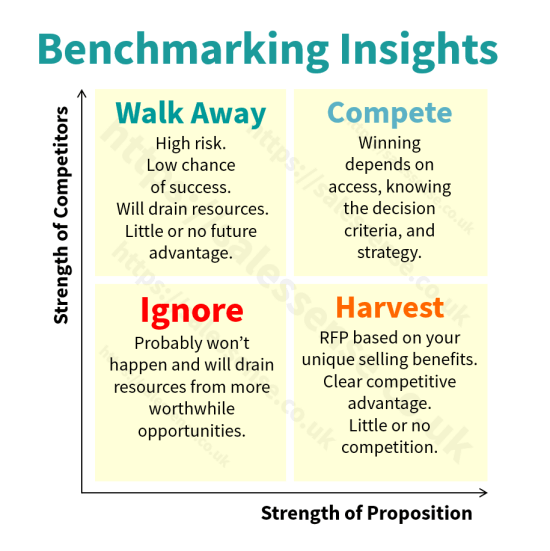
Obtaining internal data is much easier than acquiring comparable market data. Some metrics for competitors can be derived from public information sources however, most depend on obtaining cooperation via a third party or benchmarking alliance.

Despite the obvious advantages of benchmarking, and the years of management training advocating measurement, many organisations find it hard to implement. Even when the benefits are recognised and there is collective will to take advantage of these principles; even when all of the actions necessary to collect and publish the data are clear, projects falter. It seems that day to day priorities push aside such projects and undermine resolve.

An outside party, temporary employee, contractor, or consultant may be necessary to give benchmarking the impetus required for it to succeed. The return on the investment is the ability of organisations to influence or direct sales behaviour without resorting to monetary incentives. Intelligent direction of sales resources yields performance improvement.

Benchmarking is an underutilised means of leveraging motivation, raising the bar, improving or changing behaviour, and improving the sales process. It has the power to harness everyone’s will and cause it to be focused in the same direction. It is an essential element of management. As the saying goes, “if you can’t measure it, you can’t manage it.

Article by Clive Miller
Questions and comments to clive@salessense.co.uk

Shopping cart

Click title to display cart contents.

There are no products in your shopping cart.

0 Items £0.00

Event Calender

Unlock the Door - 1 day - Sept 30th 2010.

Sales Master Class - 4 days starting Oct 5th 2010.

Sell through Partners - 2 days - Oct 13th & 14th 2010.

Sales Foundation - 4 days commencing Nov 1st 2010.

Sell by Telephone - 2 days - Nov 3rd & 4th 2010.

Master Negotiation - 2 days - Dec 7th & 8th 2010.

Sell Consulting Services - 2 days - Dec 13th & 14th 2010.

Speaking on your Feet - 2 days - Dec 16th & 17th 2010.

Manage for Sales Performance - 4 days from Jan 6th 2011.

Enterprise Selling - 2 days - Jan 26th & 27th 2011.

Events Venue - Reading, close to J11 of the M4 in Berkshire.

Sales Drive

Subscribe here for the Sales Drive Journal. The latest sales and leadership ideas and practices in your inbox once a month.
CAPTCHA
Please confirm that this form has been completed by a person by answering the question below:
9 + 1 =
Solve this simple math problem and enter the result. E.g. for 1+3, enter 4.

Guaranteed 5% – 35% business performance improvement in 2 – 6 months for participating individuals and teams